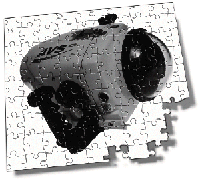
No need to puzzle it out!
Why U/W video?
In many respects underwater video is
easier and more expressive than underwater stills photography. Video camcorders operate in much lower light
than conventional film and you are virtually guaranteed a result on your very first dive. You
can playback your footage as soon as you leave the water to make sure you have
got the shot. Stills does however capture the 'decisive moment' of course (if
you're lucky!) but video is more suited to showing marine life behaviour. Video
also appeals more to the average non diver who may appreciate your footage
more than a photo.
Which Camcorder?
If you
already have a camcorder it is very tempting to find a housing for it. This is
not always the ideal solution as there are good camcorders with bad housings
(and visa versa). The problem is that they are so many camcorder manufacturers
to choose from and they are all introducing new models every couple of months.
This makes it very difficult for housing manufacturers to keep up when the U/W
market is relatively small and so they have to choose one particular line. Most
have opted for the Sony TR range and you could therefore say that this is the
industry standard for underwater video. Indeed it is very difficult to find
housings for Panasonic, JVC and Canon (even though these are all good
camcorders).
Unfortunately the
turnover of models means that the old models can become obsolete in the year
that you buy them! As a long term proposition for the underwater videographer this can be daunting.
Once you can no longer get parts for your camcorder you not only have
to throw it away when it needs to be repaired, you must also throw
away your housing!
Once you have decided on going video the choice of model depends on the
features you want. The basic difference is between the formats of tape - Video
8, Hi 8, or digital models. models are at the lower end of the price
range, but still give excellent results. Hi 8 gives better quality than video 8
but digital is best. Should your budget stretch to the higher end in a
particular range you will find these models are packed with more advanced
features.
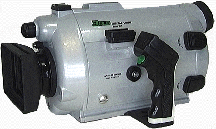
There are no
features specifically required for underwater videography. For instance
electronic steady shot, a feature designed for image stabilisation (to stop
picture wobble through camera movement) is largely obsolete underwater (where
movement is damped down anyway). However, if you will also use your camcorder to
film the kids at the fairground then you might opt for a model with this feature
anyway.
A lot of
successful videography can be attributed to post production and models with RC
time code will help editing. Most Sony camcorders have a 10x or 12x zoom
facility, date/time recording, battery capacity indicator and come with battery
charger and AC cord. Generally, the more you spend the better the picture
quality.